
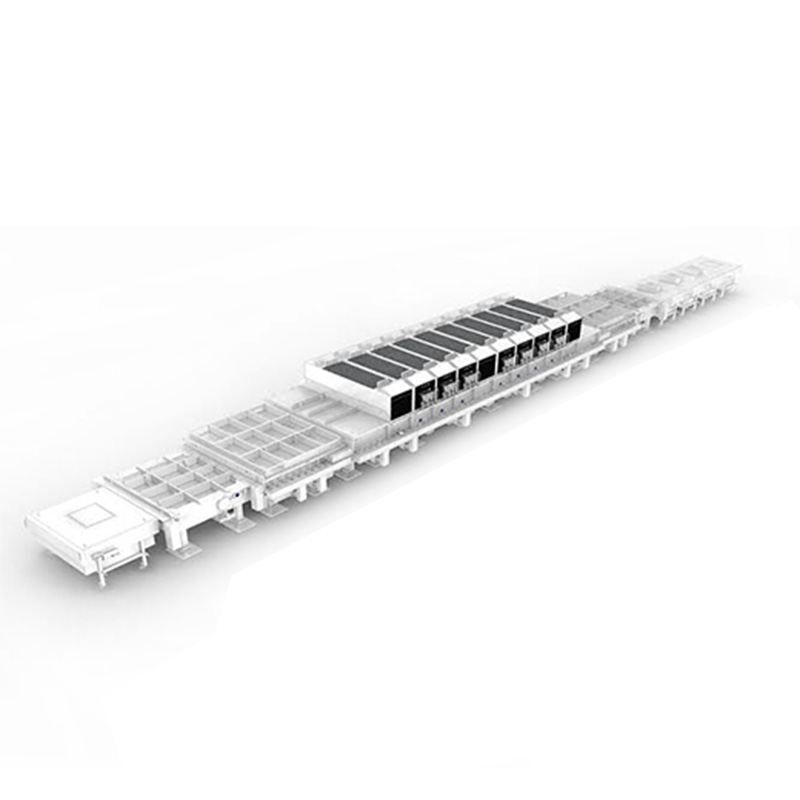
High-Performance Large-Scale Continuous Magnetron Sputtering Silver Glass Mirror Coating Line
Engineered for industrial-scale mirror manufacturing, our Continuous In-Line Magnetron Sputtering System transforms standard clear float glass into premium silver mirrors with exceptional reflectivity, durability, and uniformity. Designed for 24/7 high-volume operation, this production line integrates advanced vacuum deposition technology to deliver silver mirrors that meet or exceed global quality standards (ISO, ASTM, EN).
From raw glass loading to finished mirror unloading, the entire process runs automatically on a single, seamless production line – capable of handling glass widths up to 3.2 meters at line speeds of 3.66 meters per minute.
Technology: Rotatable Magnetron Sputtering
At the heart of the system lies closed-field, dual-rotatable magnetron sputtering. Unlike traditional wet chemistry silvering (which uses toxic silver nitrate solutions and produces hazardous waste), our dry, vacuum-based process deposits a precisely controlled multi-layer thin-film stack:
-
Pre-sputter cleaning – In-line plasma treatment removes contaminants and activates the glass surface.
-
Base layer – Either a chrome-based or silicon-based barrier layer for adhesion enhancement.
-
Silver reflective layer – High-purity silver (≥99.99%) sputtered under argon plasma to achieve a consistent, pinhole-free layer.
-
Copper protective layer (optional) – For increased corrosion resistance in humid or coastal environments.
-
Dielectric topcoat – Transparent metal oxides (e.g., TiO₂, SiO₂, or Si₃N₄) that provide scratch resistance, oxidation protection, and environmental durability.
Each cathode is powered by mid-frequency inverters (20–40 kHz) with closed-loop feedback control, ensuring layer thickness uniformity within ±2% across the entire width of the glass.
Production Line Configuration – Continuous In-Line Design
The system follows a modular, straight-line layout, minimizing footprint while maximizing efficiency:
| Station | Function | Notable Features |
|---|---|---|
| Glass Washing & Drying | Rotary brush + deionized water rinsing; hot air drying | Particle removal down to <0.5 µm; conductivity monitoring of rinse water |
| Ion Pre-Treatment | Linear ion source / plasma cleaning | Increases surface energy >72 dyne/cm for optimal adhesion |
| Sputtering Deposition Chamber | Modular cathode arrangement (up to 12 cathodes) | Rotatable targets – 95% material utilization; short changeover time |
| Post-Annealing | In-line heating zone | Stress relief and crystalline stabilization of metal oxide layers |
| Quality Inspection | Online colorimeter, reflectometer, pinhole detector | Real-time feedback to sputtering parameters; automatic rejection marking |
| Automatic Stacking & Packaging | Robotic gantry with interleaving paper | Edge alignment accuracy ±1 mm; anti-fingerprint interleaf sheet |
Specifications
| Parameter | Value |
|---|---|
| Max. glass size (width × length) | 3200 mm × 6000 mm (larger on custom order) |
| Glass thickness range | 1.1 mm – 12 mm |
| Line speed | 6 – 15 m/min (adjustable) |
| Annual capacity (2 shifts, 250 days) | > 4.5 million m² |
| Silver layer thickness | 50 – 150 nm (±2% uniformity) |
| Topcoat hardness | ≥ 3H (pencil hardness, ASTM D3363) |
| Reflectivity (visible range, 550 nm) | ≥ 92% (clear float glass substrate) |
| Coaxiality error | < 0.5 mm across 3.2 m width |
| Vacuum background pressure | 5×10⁻⁶ mbar |
| Power consumption | 180 – 250 kW (depends on line speed) |
Advantages Over Traditional Wet-Chemistry Mirror Lines
| Feature | Magnetron Sputtering Line | Traditional Wet Line |
|---|---|---|
| Environmental compliance | Closed-loop vacuum; no liquid waste | Silver nitrate & ammonia discharge requires costly treatment |
| Silver usage | 95% target utilization; minimal waste | ~60–70% silver recovery rate |
| Coating uniformity | ±2% thickness variation | Up to ±10% |
| Adhesion & durability | Excellent (metallic bond to glass) | Moderate (chemical bond, prone to edge corrosion) |
| Scratch resistance | High (dense oxide topcoat) | Low (soft paint backing required) |
| Line footprint | Compact – 35–50 meters length | Longer (drying tunnels, multiple baths) |
| Changeover to AR/IR glass | Yes – same chamber (different target materials) | No – separate line |
Quality Certifications & Testing
Every production line is delivered with factory acceptance test (FAT) and site acceptance test (SAT) protocols.
Turnkey Services – From Design to Production
We don't just sell machines – we deliver complete manufacturing solutions. Our turnkey package includes:
-
Factory layout design – Optimized material flow, utility connections (chilled water, compressed air, exhaust).
-
Target material supply – High-purity silver (99.99%) and ceramic rotatable targets (first batch included).
-
Training – On-site training for operators, maintenance engineers, and QC staff.
-
Remote diagnostics – 24/7 telemetry and live support via secure VPN.
-
Spare parts kit – 2-year critical spares (cathode shields, power supply modules, seals).
Applications of the Finished Silver Mirrors
Your sputtering line will produce mirrors suitable for:
-
Architectural glazing – High-durability mirrors for hotels, gyms, and commercial buildings.
-
Automotive – Interior and exterior mirrors (ECE R46 compliant).
-
Solar power – Parabolic trough reflectors for concentrated solar plants (CSP).
-
Furniture & interior design – Distortion-free ultra-clear mirrors.
-
Optical equipment – Precision mirrors for telescopes, projectors, and laser systems.
ROI & Competitive Edge
Compared to a traditional wet line of similar capacity:
-
Lower operating cost – No chemical consumables, less silver waste, 30% less energy per m².
-
Faster color change – Switching from copper-backed to silver-backed takes < 15 minutes vs. hours of bath drainage.
-
Warranty advantage – Offer 15–20 years mirror warranty (possible thanks to superior coating adhesion).
Contact Us for a Custom Quotation
Our engineering team will analyze your target glass size, desired output volume, and available facility space to propose an optimized line configuration. We welcome customer-owned target materials and can customize cathode geometry for special alloy layers.